Choosing the best water filter and softener in 2026 is not a simple shopping decision. Water chemistry changes from one neighborhood to another. A clear glass can still contain chlorine, lead, PFAS, sediment, or excess minerals. Hard water may also leave white scale around faucets and shorten the life of heaters and appliances.
Dr. Joseph Cotruvo, a respected water-quality scientist and former EPA adviser, has emphasized, “There is no single treatment process that removes all contaminants.” That principle should guide every buying decision. The best system depends on your water report, household size, plumbing, maintenance habits, and budget. It is not always the largest unit.
This guide compares filtration and softening technologies used in modern homes. It examines activated carbon, reverse osmosis, ion exchange, template-assisted crystallization, and combination systems. Certification matters, especially NSF/ANSI 42, 53, 58, and 44 standards. However, certification does not mean a product solves every water problem. Read the exact claim.
Some details are easy to miss. A softener reduces hardness, but it may not remove bacteria or volatile chemicals. A filter can improve taste, yet it may not protect pipes from scale. Salt use, wastewater, replacement cartridges, and installation space also deserve attention.
Real homes are imperfect.
That is where this comparison becomes useful. It considers measurable performance, operating costs, service support, and everyday experience. We will also question impressive marketing claims, because a polished label cannot replace independent testing. The right water filter and softener should make water safer, plumbing cleaner, and maintenance manageable without creating new practical problems.
Choosing the best water filter and softener starts with measuring hardness, not guessing from cloudy water. The U.S. Geological Survey classifies 121–180 mg/L as hard water, measured as calcium carbonate. That level can leave white scale on faucets, glass, showerheads, and heating elements. USGS also lists water above 180 mg/L as very hard. The number matters.
A simple home test strip gives a useful estimate, but a certified laboratory test is more dependable. Water Quality Association guidance commonly converts hardness into grains per gallon, with one grain equaling about 17.1 mg/L as calcium carbonate. If testing shows 150 mg/L, that equals roughly 8.8 grains per gallon. A softener may then be appropriate, while a carbon filter mainly improves taste, odor, and some chemical contaminants. It does not remove hardness. Easy mistake.
The U.S. Environmental Protection Agency does not set a federal health limit for hardness, because hardness is usually an aesthetic and plumbing concern. However, excessive scale can reduce water-heater efficiency and shorten appliance life. NSF/ANSI 44 provides performance requirements for residential cation-exchange water softeners, so certification offers a stronger comparison point than advertising claims. I would test both untreated and treated water, because household plumbing can affect results. One reading is not enough.
The best system depends on the risk inside your water, not its appearance. Clear water can still contain unwanted substances. NSF/ANSI 42 covers aesthetic concerns, including chlorine taste, odor, and visible particles. It improves drinking comfort, but it does not prove health protection. NSF/ANSI 53 addresses specific health-related contaminants, such as lead, when the product carries the correct contaminant claim. Check the certification details, not just the standard number.
NSF/ANSI 58 applies to reverse osmosis systems. These systems can reduce dissolved substances, but they need pressure, replacement membranes, and wastewater management. NSF/ANSI 44 covers water softeners designed to reduce hardness from calcium and magnesium. A softener protects pipes and reduces scale, but it is not a complete drinking-water filter. In real homes, matching both systems may work better. Still, more equipment means more maintenance. That part is often underestimated.
Tips: Test your water before buying anything. A laboratory report gives better direction than taste alone. Compare the exact contaminant claims, flow rate, filter life, and installation requirements. Inspect cartridges on schedule, even when water looks clean. A missed replacement can quietly reduce performance. No system is perfect. Recheck your choice when your water source, plumbing, or household needs change.
A water filter and softener solve different problems. Filters can reduce sediment, chlorine, or specific contaminants. Softeners remove hardness minerals, mainly calcium and magnesium. Correct sizing begins with a hardness test, not a product label. Ask for laboratory results when well water changes seasonally.
Use this working formula: hardness in grains per gallon (GPG) × daily household water use × days between regenerations.
A reasonable estimate is 60 gallons per person daily. Four people using 240 gallons daily at 18 GPG create 4,320 grains of demand. For seven days, that equals 30,240 grains. Add about 25 percent reserve for guests and peak use. The target becomes roughly 38,000 usable grains.
Do not confuse rated capacity with usable capacity. Salt settings, iron, and water temperature can reduce performance. One part per million of iron may add about four GPG of hardness equivalent. A professional should verify this adjustment.
Check peak flow too. A small unit may soften water adequately, yet cause weak showers when several taps run. That detail is easy to miss.
I have also seen estimates fail because families counted bedrooms instead of actual occupants. Recheck usage after installation. A short meter reading over one week can expose an oversized or undersized system.
Efficiency matters, but lower salt use should not create hard-water breakthrough. Reliability comes from testing, measured demand, and a regeneration schedule that matches real household habits.
Choosing the best water filter and softener in 2026 depends on household demand, not advertising claims. A four-person home may need 10–12 gallons per minute during morning use. A system with weak flow can make showers feel thin and reduce washing-machine performance. Check the published service flow rate, then compare it with your peak demand. Include pressure loss from narrow pipes and sediment buildup.
Salt efficiency deserves equal attention.
Demand-initiated regeneration adjusts salt use according to actual water consumption. Time-based systems may regenerate too often, even when the house is empty. Look for capacity ratings stated in grains and salt used per regeneration cycle. A smaller unit is not always cheaper. It may regenerate more frequently. Water hardness should be tested before sizing.
Water waste also varies widely.
During regeneration, some softeners send rinse water to the drain. Compare gallons discharged per cycle and the expected number of cycles each month. A filter may waste little water but require costly cartridge replacement. A softener may use less salt yet create more wastewater. The numbers can conflict.
Do not assume one device does everything.
Filters target particles, odors, or selected chemicals. Softeners mainly reduce hardness minerals. Independent test reports and recognized safety certifications provide stronger evidence than vague “advanced” claims. My own buying preference has changed: the lowest salt figure is not automatically best. Installation space, maintenance habits, and local water chemistry can matter more than a perfect specification sheet.
Choosing the best water filter and softener in 2026 requires more than comparing purchase prices. Certification is a practical starting point. Look for independent testing against recognized standards, and confirm which contaminants the certification covers. A filter certified for chlorine may not reduce lead, bacteria, or PFAS. A softener should show verified performance for hardness reduction and salt efficiency.
Maintenance affects long-term value more than many homeowners expect. Replace filter cartridges according to water usage, not just the calendar. Inspect the housing for leaks, especially after temperature changes. Softener systems need regular salt checks, resin-bed cleaning, and occasional professional inspection. Hard water may leave white marks on a kettle or shower screen. Those details reveal performance better than a sales chart.
Tips: Record installation dates, cartridge costs, salt use, and water-test results. Compare the yearly total, including replacement parts and service visits. Choose certified components that are easy to obtain locally. Smaller systems may cost less, but frequent replacements can quietly erase the savings. I would not treat every laboratory claim as a guarantee for every home. Water chemistry changes, and neglected maintenance can defeat excellent equipment. Test your water before deciding.
The best choice depends on the tested water quality. The comparison below uses common residential treatment categories rather than brand-specific products. Costs are typical U.S. planning ranges in 2026 and can vary by water chemistry, flow rate, installation complexity, and local labor.
| System Type | Primary Purpose | Certification or Test Standard to Verify | Typical Contaminants or Problems Addressed | Water and Salt Use | Routine Maintenance | Typical Replacement Interval | Typical Installed Cost | Typical Annual Operating Cost | Long-Term Value and Main Limitation |
|---|---|---|---|---|---|---|---|---|---|
| Point-of-Use Reverse Osmosis | Produces highly treated drinking and cooking water at one faucet. |
|
May reduce dissolved solids, lead, arsenic, fluoride, nitrate, and other listed contaminants when specifically certified. | Does not use salt. Conventional units may discharge about 2–4 gallons of reject water per gallon produced; efficient models can use less. | Replace sediment and carbon prefilters; replace the membrane when performance declines; sanitize the storage tank and tubing. |
|
$300–$1,200 | $80–$250 | Strong value when dissolved contaminants are confirmed. It is slower than a standard faucet filter, produces reject water, and normally treats only drinking water. |
| Whole-House Activated Carbon Filter | Improves taste and odor throughout the home and reduces selected chemicals. |
|
Chlorine, taste, odor, and selected organic chemicals; performance varies greatly by carbon type, contact time, and water flow. | No salt and usually no routine wastewater discharge. It can reduce flow if undersized or clogged. | Change or service the carbon media according to capacity, water use, and test results; inspect the bypass valve and housing. |
|
$800–$2,500 | $100–$500 | Good long-term value for chlorine and odor complaints. It does not soften water and should not be assumed to remove metals, nitrate, or microbes without a specific certified claim. |
| Ion-Exchange Water Softener | Reduces hardness that causes scale, spotting, and inefficient soap use. |
|
Calcium and magnesium hardness; may reduce iron or manganese only when the model is specifically rated for those conditions. | Uses salt or potassium chloride and water during regeneration. Demand-initiated systems generally use fewer resources than fixed-time systems. | Add salt or regenerant, keep the brine tank clean, check for salt bridging, and test hardness at the treated-water outlet. |
|
$800–$3,000 | $150–$500 | Often the best value for hard water because it protects plumbing and water-using appliances. It does not remove most dissolved contaminants or disinfect water. |
| Salt-Free Scale-Control System | Reduces the tendency of minerals to form hard scale without removing hardness. |
|
May reduce scale formation under tested conditions; it does not remove calcium or magnesium from water. | No salt and usually very little wastewater. Media may still require periodic flushing or replacement. | Inspect the media tank, flush the system when required, and monitor scale on fixtures and heating equipment. | Media commonly lasts about 2–6 years, depending on water quality and system design. | $700–$2,500 | $50–$250 | Useful where salt discharge or maintenance is unacceptable. It is not equivalent to a true softener and will not provide low-hardness water for testing or washing. |
| Ultraviolet Disinfection System | Inactivates microorganisms in water entering the home. |
|
Bacteria, viruses, and other microorganisms that are susceptible to the delivered UV dose; it does not remove chemicals or hardness. | No salt and no routine wastewater. Uses electricity continuously or during water demand. | Clean the quartz sleeve, replace the UV lamp, and maintain prefiltration so turbidity does not block UV transmission. |
|
$900–$2,500 | $100–$350 | High value for microbiological risk when properly sized and maintained. It requires power and does not correct chemical contamination, sediment, hardness, or taste. |
| Sediment or Spin-Down Prefilter | Protects downstream filters and appliances from sand, rust, and suspended particles. |
|
Sand, silt, rust particles, and other suspended solids, depending on the filter rating. | No salt. Reusable spin-down units may use a small amount of flushing water; disposable cartridges create replacement waste. | Flush the screen or replace the cartridge when pressure drops or sediment accumulates. | About 1–12 months for cartridges; reusable screens can last for years if maintained. | $100–$800 | $30–$250 | Low-cost protection for complex treatment trains. It cannot remove dissolved chemicals, microorganisms, hardness, or unpleasant taste by itself. |
| Combined Softener and Drinking-Water RO System | Provides whole-house hardness control plus higher-purity water for drinking and cooking. |
|
Hardness throughout the home and selected dissolved contaminants at the dedicated RO faucet. | Uses regenerant for the softener and reject water for the RO system. A demand-initiated softener and efficient RO membrane can reduce resource use. | Maintain salt and the brine tank; replace RO prefilters and postfilter; monitor membrane performance and sanitize the RO system. |
|
$1,500–$5,000 | $250–$750 | Often the most complete residential setup when both hardness and dissolved contaminants are documented. It has the highest maintenance complexity and upfront cost among these options. |
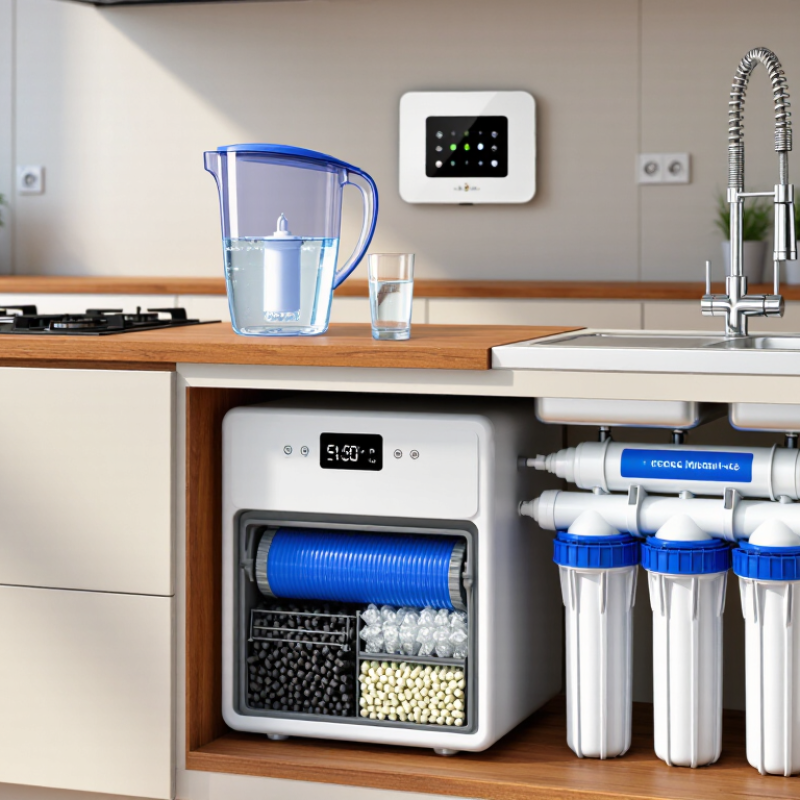
Cost ranges exclude unusual well-water treatment, major electrical work, extensive plumbing changes, water testing, and replacement of damaged household equipment. For a defensible purchase decision, test the source water first, compare certified performance claims, calculate replacement-media costs, and confirm the system’s rated flow for the household’s peak demand.